Cut to the chase
Here is how to calculate ARV (after-repair value): find at least three recent sales of renovated homes like yours, adjust each sale price for differences such as size, bathrooms and garage, and reconcile the adjusted prices into one value. ARV is what the finished house should sell for. It is not the purchase price plus the rehab cost.
At a glance
ARV comes from comparable sales, adjusted to match the finished property.
Fannie Mae's appraisal rules call for at least three closed comparables, ideally sold within the last 12 months.
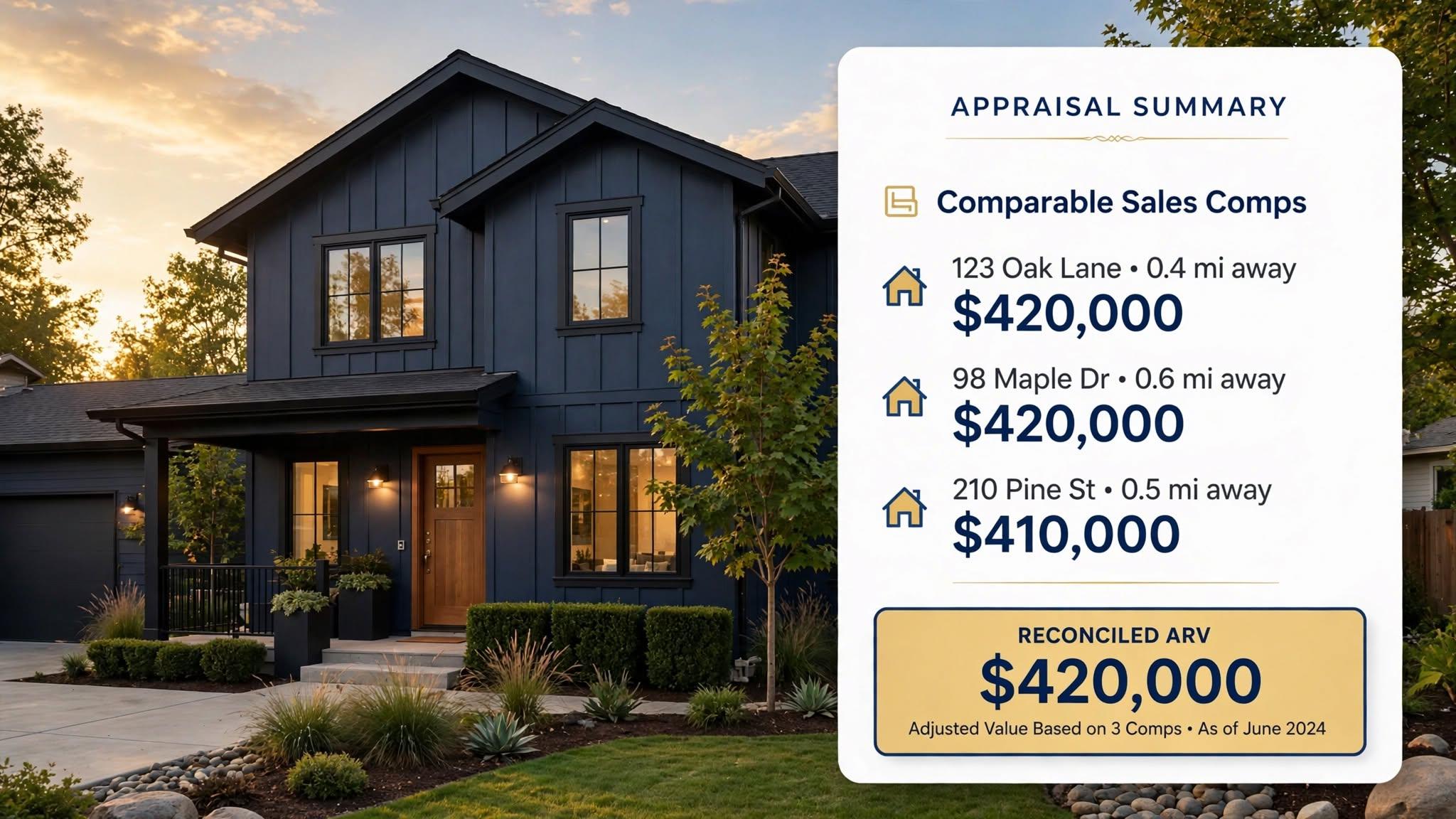
In our worked example, three adjusted comps support an ARV of $420,000.
HWC caps its fix and flip loans at 70% of ARV, so a $420,000 ARV supports up to $294,000.
A $40,000 drop in ARV cuts that limit by $28,000.
What ARV means
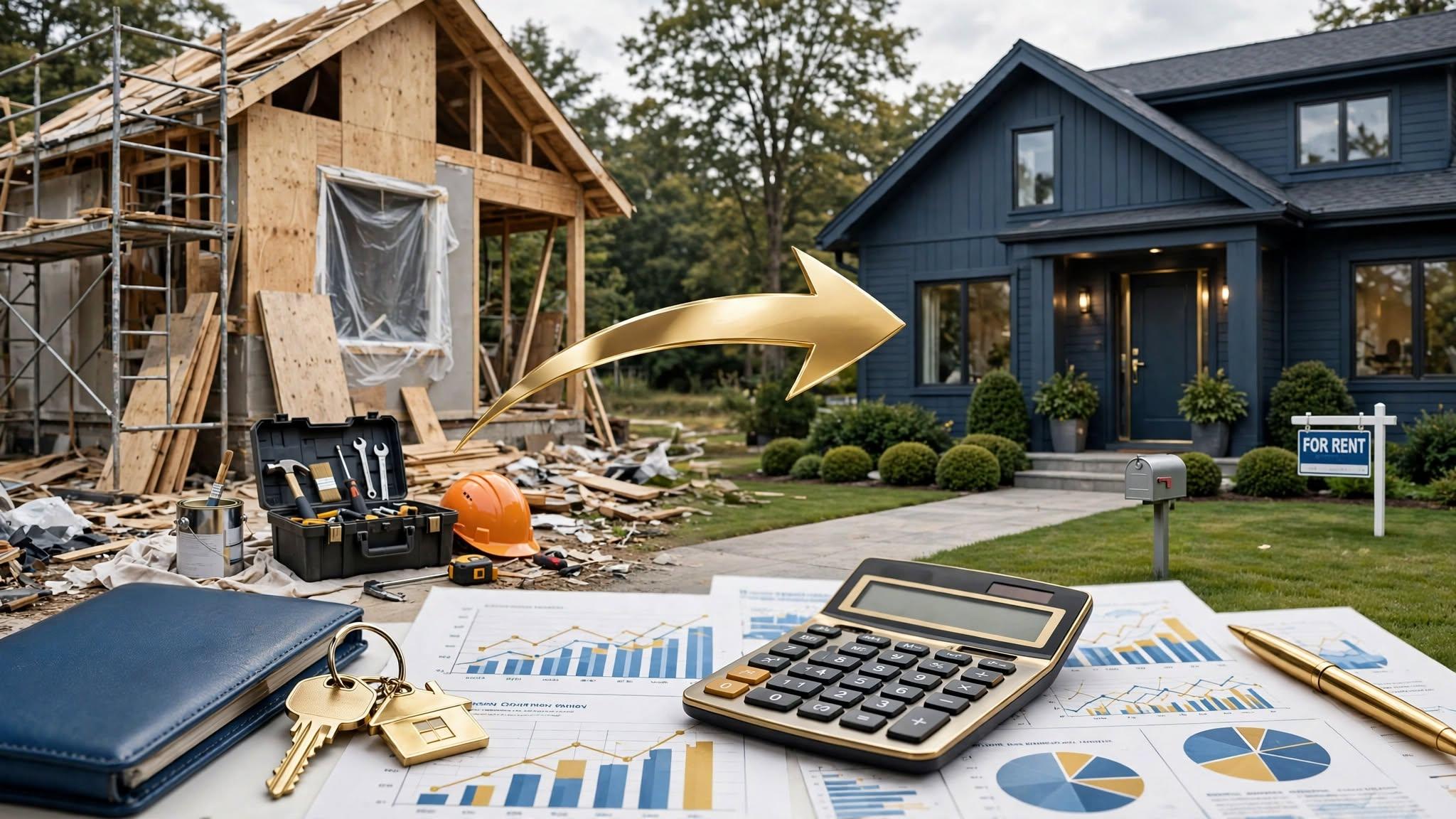
After-repair value is the price a property should sell for once the planned renovation is finished. HWC's ARV loans page describes it as an estimate built from recent sales of comparable, already-renovated homes nearby, adjusted for size, condition and features.
Two things ARV is not: it is not today's as-is value, and it is not the purchase price plus the rehab budget. A $220,000 house with a $60,000 rehab does not have a $280,000 ARV. Its ARV is whatever the market pays for a finished house like it.
How to calculate ARV in 5 steps
Describe the finished house. Write down the square footage, bedrooms, bathrooms, garage, lot and finish level after the rehab. Use your itemized scope of work, not the current condition.
Pull comparable sales. Find at least three closed sales of renovated homes in the same neighborhood. Fannie Mae's appraisal guidelines call for a minimum of three closed comparables, sold within the last 12 months and from the same market area when possible.
Adjust each comp to match your house. If a comp has something your house won't, subtract its value. If it lacks something your house will have, add it.
Reconcile the adjusted prices. Give the most weight to the comps that needed the fewest and smallest adjustments. Don't just average them.
Check it against the market. Compare the result with current listings and pending sales. If your ARV is the highest sale on the street, expect pushback.
A worked example of how to calculate ARV
The subject property is a 3-bedroom house we plan to finish at 1,500 square feet with 2 bathrooms and no garage. The adjustment amounts below are illustrative. An appraiser derives real ones from local sales data.
Comp | Sale price | Difference from the finished subject | Adjustment | Adjusted price |
|---|---|---|---|---|
A: 1,450 sq ft, 3 bed, 2 bath, renovated | $415,000 | 50 sq ft smaller | +$5,000 | $420,000 |
B: 1,600 sq ft, 3 bed, 2 bath, renovated, garage | $440,000 | 100 sq ft larger; has a garage | −$10,000 size, −$10,000 garage | $420,000 |
C: 1,500 sq ft, 3 bed, 1 bath, renovated | $395,000 | One fewer bathroom | +$15,000 | $410,000 |
The adjusted prices are $420,000, $420,000 and $410,000. Comp A needed only a $5,000 adjustment, so it gets the most weight. The reconciled ARV is $420,000. A straight average would give $416,667, which is close but ignores that Comp C needed a bigger change.
Why the price-per-square-foot shortcut falls short
A quick method divides each comp's price by its square footage and multiplies the average by the subject's size. Here the comps sold for about $286, $275 and $263 per square foot. The average, about $275, times 1,500 square feet gives roughly $412,000.
That is about $8,000 below the adjusted value because the shortcut treats a missing bathroom and an extra garage the same as square footage. Use it to sanity-check a deal, not to set your number.
Have an ARV you want checked? Send HWC the address, your comps and your scope of work. A loan officer will tell you what the numbers support. Find out if you prequalify or call 1-800-674-3804.
How lenders turn ARV into a loan
HWC's ARV loans page defines loan-to-ARV as the loan amount divided by the projected value. HWC lends up to 100% of purchase and rehab, but the total can't go above 70% of ARV. The loan is the lower of the two.
Line | ARV holds at $420,000 | ARV comes in at $380,000 |
|---|---|---|
Purchase + rehab | $280,000 | $280,000 |
70% of ARV | $294,000 | $266,000 |
Loan (lower of the two) | $280,000 | $266,000 |
Project cost the loan doesn't cover | $0 | $14,000 |
A $40,000 miss on ARV, under 10%, turned a fully funded project into one that needs $14,000 more cash. Our guide to how much cash you need to close a 100% LTC loan adds the closing costs, interest and reserves on top.
HWC releases the rehab money in draws as work is completed and verified, according to its ARV loans page. If the house will be held as a rental after the work, the finished value also sets the size of a DSCR refinance.
The 70% rule vs. a lender's ARV cap
Investors use the 70% rule as a rule of thumb for what to pay: maximum purchase price = ARV × 70% − repair costs. For our house, that is $420,000 × 70% − $60,000 = $234,000. A $220,000 purchase passes.
A lender's ARV cap is a different number. It limits the loan, not the price you pay. At HWC both happen to use 70%, but one is your offer math and the other is the most the lender will fund.
Common ARV mistakes
Using unrenovated comps. A dated house down the street tells you the as-is value, not the after-repair value.
Reaching across neighborhoods. A sale a mile away in a better school district can inflate the number. Fannie Mae's guidance favors comps from the same market area.
Using old sales. Sales older than 12 months need a time adjustment and a reason.
Budgeting a rehab that doesn't match the comps. If the comps have new kitchens and your scope doesn't, your ARV is too high.
Over-improving. Finishes above the neighborhood level rarely return their cost.
Choosing the right loan matters too. See hard money vs. bridge loans for which program fits a flip versus a larger project.
Turn your ARV into a loan amount
HWC funds up to 100% of purchase and rehab, capped at 70% of ARV, in all 50 states and D.C. Send the deal and we'll size it. Start your deal inquiry or contact our team.
Sources
Hedge Wealth Capital, ARV Loans program page
Hedge Wealth Capital, Hard Money Loans program page and calculator
Fannie Mae Selling Guide, B4-1.3-08 Comparable Sales (06/04/2025)
Miche-Nerson Brutus President and CEO, Hedge Wealth Capital
Related loan programs
ARV Loans: renovation loans sized on after-repair value, with draws as work is done.
Hard Money Loans: up to 100% of purchase and rehab, capped at 70% of ARV.
DSCR Loans: refinance a finished rental into a long-term loan.
Latest articles
How Much Cash Do You Need to Close a 100% LTC Fix and Flip Loan?
What Is a DSCR Loan? How Rental Income Qualifies You
This article is general information, not a commitment to lend or an appraisal. Financing is subject to underwriting, property eligibility, program availability and final loan terms. Examples and adjustment amounts are illustrative. Rates, fees, leverage and terms vary by transaction.