
Cut to the chase
Hard money loan points are an upfront fee, and one point is 1% of the loan amount. If a lender charges 2 points on a $100,000 hard money loan, you owe $2,000, usually due at closing. Points are only part of the bill. On the 6-month, $250,000 flip loan worked out below, points, interest-only payments and lender fees add up to $21,550 before taxes, insurance and selling costs.
At a glance
Points = loan amount x points / 100. Two points on $100,000 is $2,000.
Hard money lenders generally charge 2% to 5% in points (Rocket Mortgage).
Interest-only payment = balance x annual rate / 12. A $100,000 loan at 11% costs $916.67 a month.
Points weigh more on short holds. Two points on a 6-month loan work out to about 4% a year on top of the rate.
On HWC hard money loans, payments are interest-only for 6 to 12 months, with a $0 prepayment penalty.
What are hard money loan points?
Hard money loan points are an upfront fee the lender charges to make the loan. Each point equals 1% of the loan amount. On a mortgage, a point usually buys a lower rate. The CFPB notes that some lenders use the word for any upfront fee set as a percentage of the loan, whether or not the rate drops. That is how most hard money lenders use it. The points are their origination fee.
A Merchant Maverick guide puts hard money loan points at 2 to 5 for most lenders, paid at closing. A 2026 fee table from RentalRealEstate lists 1 to 5 points, with 1.5 to 3 the most common.
How to calculate hard money loan points
Find the loan amount on the term sheet, not the purchase price.
Divide the number of points by 100. Two points becomes 0.02.
Multiply the loan amount by that number. $100,000 x 0.02 = $2,000.
Check whether the fee is due at closing, taken from your loan proceeds or added to the balance.
Loan amount | 1 point | 2 points | 3 points |
|---|---|---|---|
$100,000 | $1,000 | $2,000 | $3,000 |
$250,000 | $2,500 | $5,000 | $7,500 |
$500,000 | $5,000 | $10,000 | $15,000 |
How interest-only payments work
Most hard money loans charge interest only. You pay no principal each month. You repay the full balance when you sell or refinance. The monthly payment is the balance times the annual rate, divided by 12.
At 11%, a $100,000 loan costs $916.67 a month. Over a 6-month hold, that is $5,500 in interest. Add the 2 points and the loan has cost $7,500 before any other fees.
Ask how the lender charges interest on rehab money. Some charge on the full loan from day one. Others charge only on funds you have drawn. On a rehab loan, the second method costs less.
Other hard money loan fees to ask about
Two lenders can quote the same hard money loan points and rate and still be thousands of dollars apart once fees are added. Ask every lender for a full fee schedule. These ranges come from the RentalRealEstate 2026 table.
Fee | Typical range (2026) | When you pay it |
|---|---|---|
Processing or underwriting | $500 to $1,500 | At closing |
Appraisal or BPO | $100 to $800 | Before closing |
Legal or document prep | $500 to $1,500 | At closing |
Draw inspection | $100 to $250 per inspection | Each rehab draw |
Extension | 0.5% to 2.0% per extension period | If the loan runs past its term |
Exit or payoff | 0% to 1% | At payoff (not all lenders) |
Title, recording and closing attorney fees are third-party costs. They vary by state, so get a quote for your property.
Worked example: the full cost of a 6-month flip loan
Illustrative numbers only. The rate and fees are assumptions, not an HWC quote.
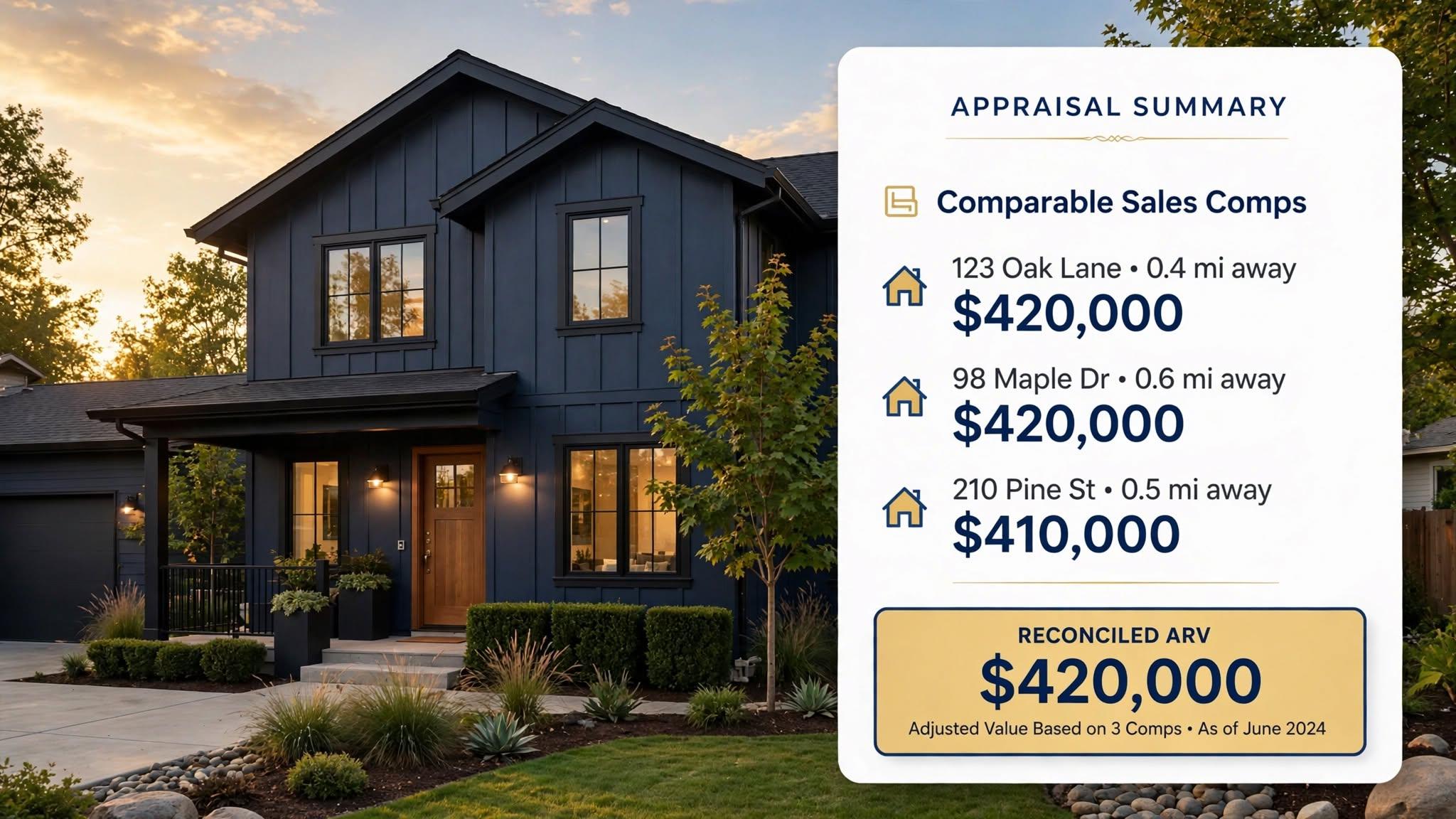
An investor buys a house for $200,000 with a $50,000 rehab budget. The after-repair value is $360,000. (See how ARV is calculated, with a worked example.) A 70% ARV cap allows up to $252,000, so the lender can fund 100% of the $250,000 project. The loan carries 11% interest and 2 points, with two rehab draws.
Hard money loan points: $250,000 x 0.02 = $5,000.
Interest: $250,000 x 0.11 / 12 = $2,291.67 a month. Six months = $13,750.
Lender fees: $1,000 processing, $500 appraisal, $1,000 document prep.
Draw inspections: 2 x $150 = $300.
Cost item | Amount |
|---|---|
Points (2) | $5,000 |
Interest, 6 months on full balance | $13,750 |
Processing and underwriting | $1,000 |
Appraisal | $500 |
Document prep | $1,000 |
Draw inspections (2) | $300 |
Total financing cost | $21,550 |
That is 8.6% of the loan amount. If interest applies only to drawn funds, and the two $25,000 draws go out at months 2 and 4, interest falls to $12,375. The total drops to $20,175.
If the sale slips by two months, a 1% extension fee adds $2,500, plus $4,583.33 in interest. The total rises to $28,633. Extension terms are often a reason investors weigh a hard money loan against a bridge loan.
Even at 100% financing, you still bring money to the table. This article on cash to close on a 100% LTC fix and flip loan walks through it.
[ADD: Verified HWC funded deal (with borrower permission): purchase, rehab, ARV, loan amount, points, hold time and actual total financing cost.]
Want this math run on your deal?
Send HWC the purchase price, rehab budget and ARV. You get an itemized cost estimate with points, interest and fees. Find Out If You Prequalify or call 1-800-674-3804.
Hard money loan points vs. rate: which offer costs less?
A lower rate with more points only pays off if you hold the loan long enough. Compare two offers on a $250,000 loan.
Hold time | Offer A: 1 point, 12% | Offer B: 3 points, 10% | Cheaper |
|---|---|---|---|
6 months | $17,500 | $20,000 | A by $2,500 |
12 months | $32,500 | $32,500 | Even |
18 months | $47,500 | $45,000 | B by $2,500 |
Totals are points plus interest-only payments. Illustrative rates.
Most flips run 6 to 12 months, so fewer points usually win. Lenders also price points by the deal: experience, credit and loan size all move the number. To compare any two offers, divide the extra points by the rate difference. Here, 2 extra points / 2% lower rate = 1 year to break even.
Paying hard money loan points upfront, from proceeds or rolled in
Paid at closing. You bring the cash. This is the most common setup.
Deducted from proceeds. The lender holds back the fee. Herring Bank gives the example of a $300,000 loan with 3 points, where the borrower receives $291,000.
Rolled into the loan. You pay interest on the fee. In the example above, rolling in $5,000 adds $275 of interest over 6 months. It also raises the balance to $255,000, which is over the $252,000 ARV cap.
How HWC structures hard money loan costs
HWC hard money loans for flipping houses fund up to 100% of the purchase price and 100% of the rehab budget, subject to a 70% ARV cap. Payments are interest-only for 6 to 12 months. There is a $0 prepayment penalty, so selling early cuts your interest cost. Borrowers pay closing costs and any spending outside the approved budget. An option with no upfront origination points is available. Ask for its terms when you request a quote.
If the flip becomes a rental, you can refinance into a 30-year DSCR loan. Here is how rental income qualifies you for a DSCR loan.
Get your real numbers before you make an offer
HWC can prequalify you before you find the deal, so you know your points, rate and cash needed up front. Find Out If You Prequalify or call 1-800-674-3804.
Sources
CFPB: How should I use lender credits and points?
Rocket Mortgage: What are hard money loans and how do they work?
Merchant Maverick: Guide to hard money business loans for real estate
RentalRealEstate: Investment property hard money loan rates and fees (April 2026)
Herring Bank: Hard money loans, how they work and when to use them